
Radiopharmaceuticals Development
Overview
The Department of Radiopharmaceuticals Development owns 5 hot laboratories for manufacturing radioactive drugs. Some of them can support GMP. We have a small cyclotron and a medium-sized one. So, we can produce not only positron emitters such as 11C, 13N, 15O, 18F, 68Ga for PET diagnosis, but also astatine-211 (211At) which is recently attracted attention as an alpha emitter for radiopharmaceutical therapy. Therefore, we can manufacture and synthesize various radiopharmaceuticals. Some radiopharmaceuticals are available for clinical application, and the others are proceeding with the development and research as diagnostic or therapeutic agents using evaluation by animal experiments.
Department Activities
Radiopharmaceuticals Development
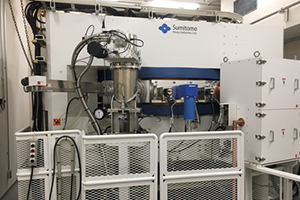
In the Department of Radiopharmaceuticals Development, we introduced two cyclotrons (compact HM-20, medium-sized MP-30) to produce radionuclides.
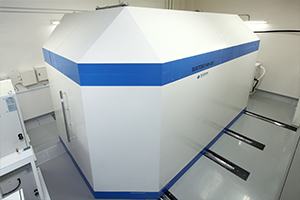
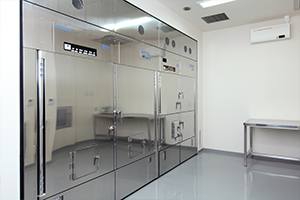
We provide radiopharmaceuticals from radioactive nuclides produced by our small cyclotron. We produce for diagnosis as 18F-fluorodeoxyglucose (18F-FDG) for Imaging glucose metabolism, 13N-ammonia for myocardial blood flow imaging, and 15O gases for cerebral blood flow, cerebral oxygen consumption and cerebral blood volume imaging.
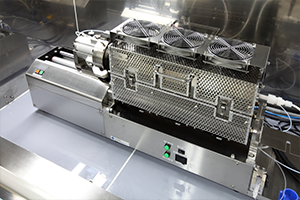
In addition, we produce for clinical research as 11C-methionine for amino acid metabolism, 11C-PiB for β-amyloid imaging. And we also produce some other radiopharmaceuticals in order to promote research.
On the other hand, the medium-sized cyclotron can accelerate α particles of 30 MeV, and we produce 211At which is an α-ray emitting nuclide with a half-life of 7.2 hours. In recent years, the effectiveness of α-ray emitting radionuclides in nuclear medicine therapy (RI internal radiotherapy) has attracted considerable attention. We have been conducting the first-in-human trial of ²¹¹At-MABG, a therapeutic drug candidate for malignant pheochromocytoma, as well as a Phase I trial of ²¹¹At-NpG-PSMA, a therapeutic drug candidate for prostate cancer.
Preclinical Development
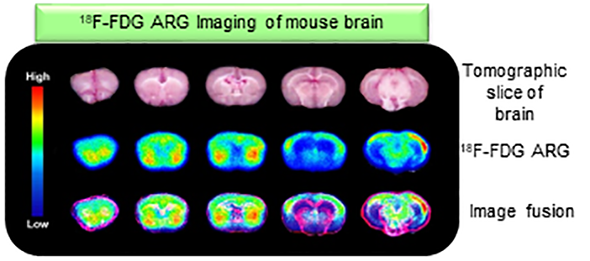
We have more than 200 isolation-type breeding cages, and the entire facility is maintained in an SPF environment, where advanced cell and animal experiments can be carried out. Since a quarantine room is available, breeding and experimenting on animal models with special diseases and genetically modified animal models can also be carried out. The facility is equipped with a PET/SPECT/CT imaging system, an optical imaging system, an autoradiography (ARG) device, a histopathological image-analysis device, a multitype radiation measurement device and analyzer, an automated high-speed cell sorter, a quantitative protein analyzer, an automated veterinary hematology analyzer, and a blood biochemical measuring instrument for high-precision measurements.
In this facility, we are conducting the following: pharmacokinetics and pharmacological tests using radiolabeled compounds and biological function imaging using the PET/SPECT/CT system, elucidation of biological functions and evaluation of metabolism and function using animal disease models with the PET/SPECT/CT, optical, evaluation of treatment effects and prognostic predictions by in vivo imaging, and development of new radiation therapies using astatine-labelled agents.
Up to now, we have been actively engaged in conducting biodistribution and efficacy studies, as well as extended single-dose toxicity evaluations, in preparation for the first-in-human trial of ²¹¹At-MABG, a therapeutic drug candidate for malignant pheochromocytoma, and the Phase I clinical trial of ²¹¹At-NpG-PSMA, a therapeutic drug candidate for prostate cancer.